📈 Mastering Health Data Analytics: A CPHQ Preparation Guide
In today's healthcare landscape, data isn't just information — it's the foundation of smarter decisions, better patient outcomes, and more efficient systems. Our recent sessions delved deep into Health Data Analytics, a critical component of the Certified Professional in Healthcare Quality (CPHQ) exam and modern healthcare quality improvement practices. Here’s a complete roundup of what we explored.
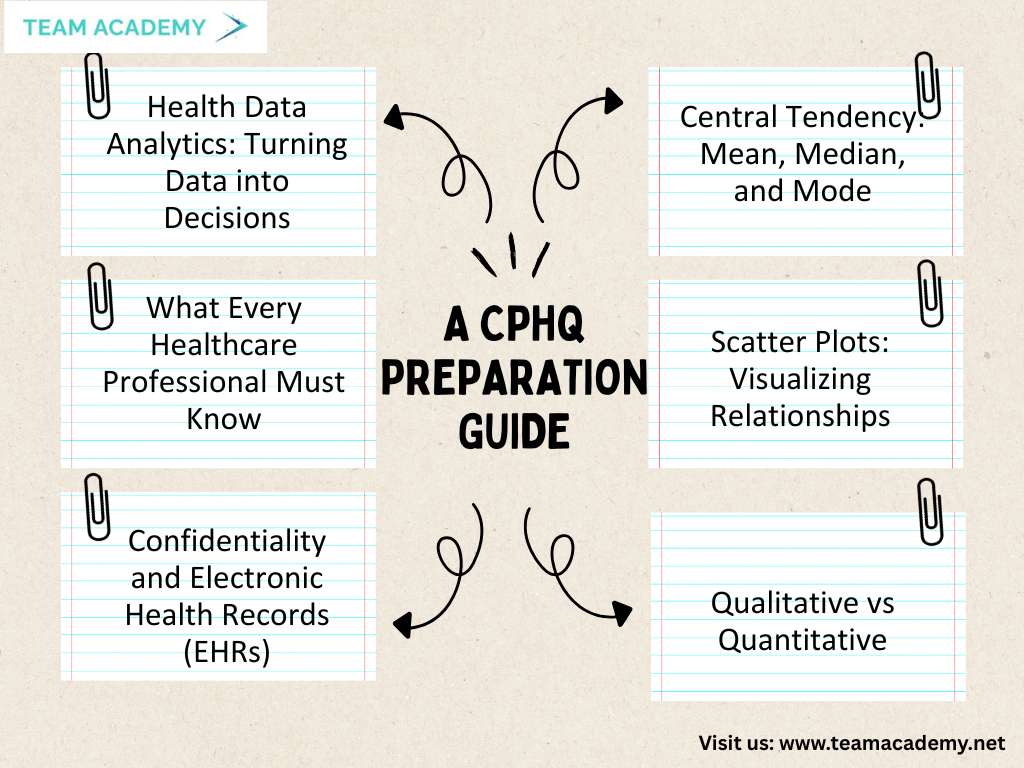
🧠 Health Data Analytics: Turning Data into Decisions
Health data analytics transforms vast amounts of raw data into actionable insights for healthcare quality improvement. As we discussed:
Analytics is crucial for CPHQ exam success and everyday healthcare leadership.
Preparation matters: Review your course materials thoroughly before sitting for the exam — it’s a significant investment.
Application in Healthcare: From improving care delivery to optimizing operational efficiency, data analytics is at the heart of every modern healthcare system.
🔒 Data Privacy and Big Data: What Every Healthcare Professional Must Know
Data is everywhere — on social media, at airports, and especially in hospitals.
We explored the 5 V’s of Big Data:
📦 Volume – Massive amounts of information
⚡ Velocity – Data generated at high speed
🎨 Variety – Different types and formats
✅ Veracity – Reliability and accuracy
💰 Value – Turning data into meaningful insights
Protecting sensitive healthcare data is non-negotiable. With growing cyber threats, we must safeguard patient information and ensure responsible data management practices at all times.
📑 Confidentiality and Electronic Health Records (EHRs)
Healthcare organizations must handle Protected Health Information (PHI) with the highest level of care.
Key Points:
Only disclose PHI to authorized personnel or entities.
Unauthorized access can lead to serious consequences, including termination.
EHR Benefits: Easier documentation, improved communication among providers, and better record-keeping.
Challenges: System downtime and high implementation costs.
Hospitals are legally obligated to protect patient records under both local and international data privacy laws. 📜
🛡️ Securing Data Against Cyber Threats
Cybersecurity isn’t optional—it's essential.
Major risks include:
🕵️ Criminal groups and espionage
🌍 Nation-state cyberattacks
🏢 Insider threats
We discussed real-world threats, including ransomware and deepfake scams, highlighting the need for:
Complex passwords
Disabled USB ports
Firewalls and insider threat monitoring
🔐 "In cybersecurity, prevention is always cheaper than cure."
📊 Understanding Data Types: Qualitative vs Quantitative
Good decisions depend on understanding the right type of data.
-
Qualitative Data (Categorical)
Nominal: No natural order (e.g., blood type)
Ordinal: With natural order (e.g., pain scale)
-
Quantitative Data (Numerical)
Discrete: Whole numbers (e.g., number of visits)
Continuous: Decimals/fractions (e.g., blood pressure)
⚡ Quick Tip: Data is meaningless until it’s interpreted correctly. Always analyze before acting.
📈 Scatter Plots: Visualizing Relationships
We explored scatter plots and how they help us make decisions:
Example:
📈 More exercise time ➔ More calories burned
Scatter plot correlations:
Positive Correlation: Both variables increase together
Negative Correlation: One variable increases as the other decreases
No Correlation: No obvious relationship
Scatter plots are one of the 7 Basic Quality Tools — easy to use, but powerful for spotting patterns at a glance. 🔍
🎯 Central Tendency: Mean, Median, and Mode
We wrapped up with an essential topic in statistics: central tendency.
Key Definitions:
Mean: The average value (sensitive to outliers)
Median: The middle value (more reliable with skewed data)
Mode: The most frequently occurring value
Range: Difference between the highest and lowest values
🔔 "In healthcare analytics, the median often tells a truer story than the mean."
Understanding these basics sets the groundwork for more advanced analyses in healthcare quality projects.
🚀 Moving Forward
As we prepare for the CPHQ exam and build our real-world healthcare skills:
Stay vigilant about data privacy and security.
Understand and analyze data types before drawing conclusions.
Use analytics tools like scatter plots and central tendency measures to drive quality improvement.
Practice ethical leadership in managing patient data and organizational change.
Healthcare is evolving—and so must we. Keep learning, stay prepared, and lead the change toward a better, data-driven future.
🎯 Ready to take your healthcare analytics skills to the next level?
📥 Course details: Click here
📥 Enroll Now…!